

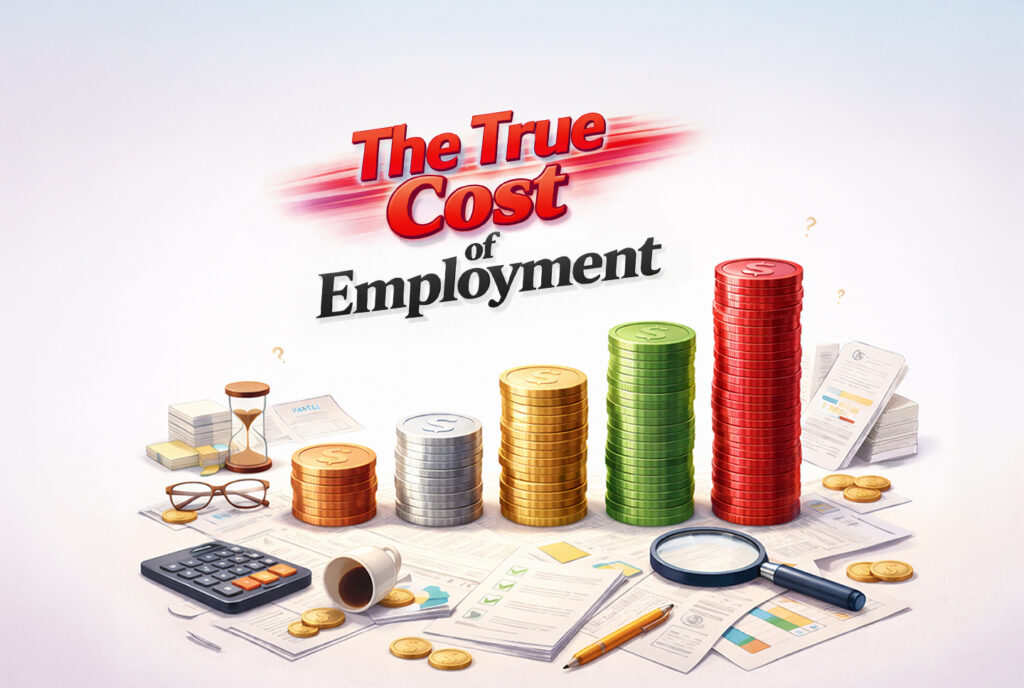
What a $21/Hour Hire Actually Costs You in 2026
Early this year, we ran a five-part series on the True Cost of Employment. New data from the Bureau of Labor Statistics data has since been released – so let’s revisit the number, simplified.
Quick recap: last time, we showed that a $21/hour Customer Service Representative doesn’t cost you $21/hour. Between legally required taxes, health insurance, recruiting, and administrative overhead, the real number lands well above base pay – most business owners underestimate it significantly.
The new BLS Employer Costs for Employee Compensation report (March 2026) gives us a chance to check that math. Here’s the updated breakdown.
The Stack
Base Pay: $21.00/hour
Payroll Taxes & Workers’ Comp: +$1.82/hour Social Security, Medicare, unemployment insurance, and workers’ comp haven’t moved much – these are mostly fixed by law and stayed essentially flat year over year.
Health Insurance: +$4.81/hour Blending single coverage ($6,500–$7,500) and family coverage (~$20,000) across a typical enrolled workforce, average employer cost runs about $10,000 per employee annually. Health insurance premiums keep outpacing both inflation and wage growth – still the single biggest benefit expense on the list.
Recruiting: +$1.92/hour Job postings, screening, background checks, and onboarding still average around $4,000 per hire, per SHRM. With CSR attrition running 30–45% annually, this cost repeats – often more than once a year per seat.
Administrative Overhead: +$0.79/hour Payroll processing, benefits administration, compliance, HR software – the infrastructure tax that exists whether or not an employee is fully productive yet.
Paid Leave, Retirement, and Supplemental Pay: +$4.51/hour combined Vacation, holidays, sick time, retirement contributions, and shift differentials/bonuses round out the picture.
The Real Total
$34.85/hour | 66% above the $21 base pay rate.
That’s before factoring in the cost of a bad hire, extended vacancies, or the time your team spends managing all of this instead of running the business.
What’s Actually New This Year
If you read last time: the framework hasn’t changed, but the pressure point has. Payroll taxes, retirement match, and administrative costs are holding steady as a share of wages. Health insurance is the one line still climbing faster than paychecks – and it’s the hardest one for a business owner to control on their own.
The InnoSource Advantage
InnoSource handles payroll taxes, health insurance administration, 100% of recruitment costs, and all administrative infrastructure – for less than what it costs most businesses to do it themselves.
Ready to see your actual numbers? Contact us today at [email protected] and let’s calculate what your specific roles really cost – and how much you could save.